Substrate
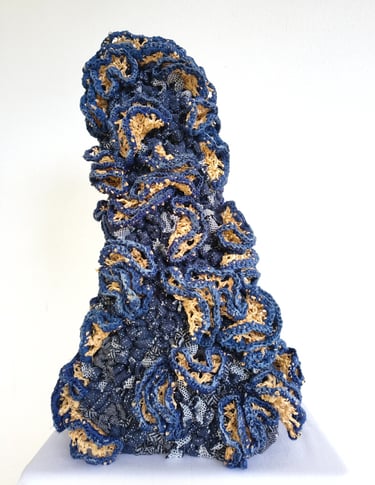
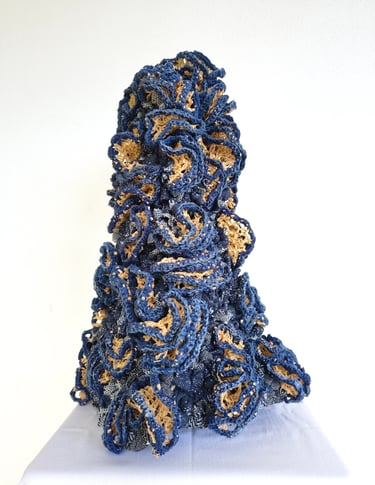
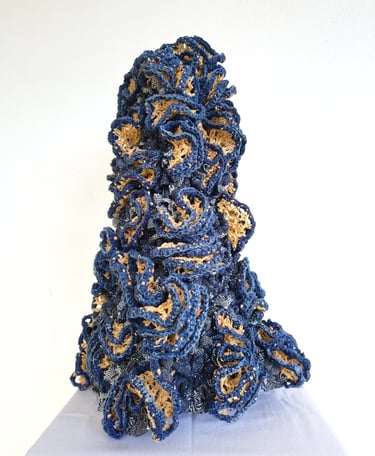
Substrate series reflects on how experiences, habits, social roles, and memory accumulate over time, reshaping the self.


Built slowly by hand from raffia, textile, and recycled materials, the sculpture develops through repetition and accumulation, mirroring the gradual formation of human identity itself.
Substrate (a) is the first work in the series. Further pieces will explore new forms, scales, and configurations — tracing the endless variety of ways we learn to inhabit ourselves.
Substrate
The Substrate series began with the image of lichen growing across tree bark. I was drawn to the way it forms a kind of wild, organic garment — a layer that slowly covers the surface, transforms it, and can make even old or weathered wood appear complex and beautiful.
This image became a metaphor for the layers that accumulate around us over time. Experience, memory, habits, fears, protective mechanisms, social roles, relationships, and the ways we choose to live and present ourselves all leave traces. They shape the surface through which we encounter the world — and through which the world encounters us.
These layers are not necessarily negative. They can protect us, become part of our identity, and create something unique, complex and beautiful. But they can also become so dense that what lies beneath becomes difficult to see, even to ourselves.
Perhaps we sometimes fall in love not with life itself, but with its outward signs. We read depth into gestures, beauty into surfaces, vitality into movement. But can a surface tell us whether there is still life underneath? And what happens when a layer created to protect us becomes so dense that it no longer allows contact with what lies beneath?
In Substrate, the surface simultaneously conceals, protects and creates a new form. The work leaves open the question of where the substrate ends and the shell begins — and whether what we call a surface might, over time, become part of what lies underneath.